
AI Doomerism: A History of Patterned Consensus and Deceit
Summary
AI is dangerous. AI can already be weaponized for cyberattack, surveillance, fraud and war.
But AI as an existential threat to humanity is an entirely different proposition. This is a forecast about systems that do not yet exist.
History is littered with authoritative consensus mechanisms that converted real or imagined risks into apocalyptic forecasts, demanded extraordinary action, and subsequently produced worse outcomes for humanity. AI Doomerism increasingly exhibits the same epistemic pattern - except this time the incentives are unusually visible: an Effective Altruist safety movement, incumbent AI companies preparing for IPOs, regulatory moats protecting proprietary models, and an intensifying technological war with totalitarian China.
The antidote is neither complacency nor fear: evidence before fear; mechanism before mandate; falsifier before forecast.
TL:DR: just like countless examples before it, AI is not an existential threat to humanity.
Failed Reasoning of the Past
We have seen this patterned thought before. And, every time, the forecasts have failed to produce the projected outcome.
In fact, technological Doomerism predates the nuclear age by nearly a century.
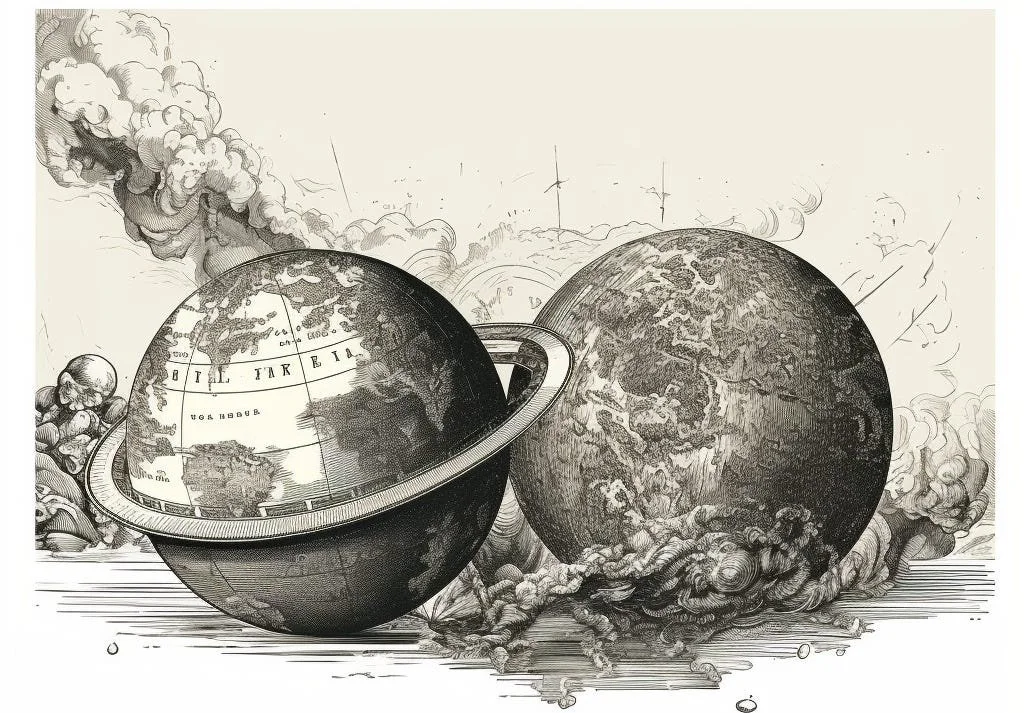
The Telegraph.
In 1881, as plans advanced to encircle more of the earth with telegraph wire, The New York Times cited what it described as research from a “prominent academic journal” warning of an extraordinary new threat to the planet. h/t Lewis Anslow on Substack, where I found this amazing history first.
The theory was that wrapping the earth in continuous electrical wire could interfere with the electrical currents supposedly controlling the earth’s poles. That interference could move the poles, change the earth’s axis, melt the polar ice, flood the planet and even “upset the whole time table of the solar system” enough to produce “a series of frightful collisions.”
The imagined consequences became almost comical. Polar ice would melt into a biblical deluge. Africa might become a frozen polar region. New York could become tropical. Central Park might fill with monkeys and parrots.
The telegraph, in other words, wasn't merely going to disrupt society.
It might rearrange the solar system.
The telegraph survived. So did the earth’s axis.
And, inconveniently for the prediction, the communications infrastructure descending from telegraphy eventually became foundational to the telephone, internet and the very global information system through which today's Doomers communicate their warnings.
Guam.
The telegraph actually reminds me of the former Democrat Representative from Guam who, in 2007, testified of his concern that the U.S. Military was going to literally tip over the island of Guam.
"My fear is that the whole island will become so overly populated that it will tip over and capsize."
Machine Supremacy.
Even more remarkable is that the essential AI extinction argument itself is at least 163 years old.
In 1863, Samuel Butler published Darwin Among the Machines in The Press in Christchurch, New Zealand. The original newspaper survives.
Butler observed how rapidly machinery was improving compared with biological evolution and asked what species would eventually succeed man as the dominant creature on earth.
His answer was the machines.
“We are ourselves creating our own successors,” Butler wrote. Humans were continually giving machines greater power and increasingly self-regulating capabilities. Eventually, he predicted, “the machines will hold the real supremacy over the world and its inhabitants.”
His prescription sounds almost eerily contemporary:
“war to the death should be instantly proclaimed against them.”
Every machine should be destroyed, Butler argued, before mankind created something it could no longer control. If technological society had already become too dependent upon machinery to stop, Butler reasoned, that merely demonstrated that human servitude to machines had already begun.
Strip away the steam engines and Victorian prose and the structure is astonishingly familiar:
Machines are improving extraordinarily quickly. Human beings are giving them increasing autonomy. Their evolution may eventually exceed ours. We are creating our own successor. Eventually the machines may dominate humanity. Once they become sufficiently powerful, we may no longer be capable of stopping them. Therefore development must be stopped before the point of no return.
That was written in 1863.
Before the automobile. Before the airplane. Before electricity reached most homes. Before radio, television, nuclear physics, transistors, computers, the internet or artificial intelligence.
The technological object changed spectacularly. The reasoning barely changed at all.
Butler even declared machine supremacy essentially inevitable - something that “no person of a truly philosophical mind” could question.
That sentence deserves attention because it reveals another recurring feature of Doomerism: uncertainty about an unprecedented future technology becomes transformed into certainty about its catastrophic endpoint.
And once the prediction contains no date by which it must occur, falsification becomes conveniently difficult. Humanity can live alongside increasingly powerful machines for 10 years, 50 years, 100 years or 163 years, and the response can always remain:
Just wait.
The machine apocalypse may forever remain one more generation of machinery away.
Other Examples
Cold War nuclear extinction was treated as a plausible end of humanity. The weapons were real; extinction did not occur.
Paul Ehrlich’s The Population Bomb opened with the declaration that “the battle to feed all of humanity is over” and forecast that hundreds of millions would starve during the 1970s and 1980s. He declared the debate settled but the catastrophe never arrived. Smithsonian’s retrospective concluded that most of the extreme environmental conditions predicted around the first Earth Day had, decades later, failed to materialize. Earth Day-era forecasts similarly warned of exhausted resources and ecological collapse by 2000. Those also failed.
The mistake was not merely arithmetic. Ehrlich treated humans principally as mouths consuming a finite quantity of resources. Julian Simon treated humans as minds capable of responding to scarcity through prices, substitution, invention, efficiency and discovery. Reality sided with Simon.
COVID showed the same failure to reason: a real danger was followed by policies that overstated the evidence - we shut society down to “flatten the curve” and then infringed on the most basic freedoms of human rights. We started imprisoning people standing outside on the beach by themselves, as if we were a totalitarian state indifferent to the worst in history.
Then CLIMATE inherited the apocalyptic vocabulary. In 2019, The Guardian explicitly shifted its language toward “climate emergency, crisis or breakdown” because the older terms sounded too “passive and gentle.” Sure, sea level is rising, but it’s been rising at about 3 mm/year for the past seven thousand years. That’s about one foot of rise per 100 years, i.e. not an existential threat to humanity.
Fear has a peculiar way of reporting only one side of the ledger. Fear tends to be the lie that made its way around the world before the truth got out of bed.
Hans Rosling, Al Gore, and the Problem With Fear
There is a revealing story buried in Hans Rosling’s Factfulness that deserves considerably more attention –
“there are no room for acts, when our minds are occupied by fear.”
As I wrote in Fear, Rosling was the Swedish physician, statistician and founder of Gapminder who became famous for using data visualization to demolish widespread misconceptions about poverty, population, health and human development. His life’s work was essentially an argument that our intuitions about the world are systematically distorted by fear, negativity, urgency and our attraction to dramatic stories.
In 2009, backstage at a TED conference in Los Angeles, Rosling met Al Gore to discuss communicating climate change. According to Rosling, Gore began with five remarkable words: “We need to create fear!”
“We need to create fear!” that’s what Al Gore said to me at the start of our first conversation about how to teach climate change… but I couldn’t agree to what he had asked. I don’t like fear. Fear of war plus the panic of urgency made me [incorrectly] see a Russian pilot and blood on the floor. Fear of pandemic plus the panic of urgency made me close the road and cause the drownings of all those mothers, children, and fishermen. Fear plus urgency make for stupid, drastic decisions with unpredictable side effects… Al Gore continued to press his case for fearful animated bubbles beyond the expert forecasts, over several more conversations until, finally, I closed the discussion down.”
Gore wanted Rosling to use Gapminder’s celebrated animated bubble charts to illustrate the worst-case future consequences of continued increases in CO₂.
Rosling insisted that if he showed the worst case, he also had to show the probable case and best case. Taking the frightening extreme, projecting it forward and using Gapminder’s credibility to frighten an audience violated the entire epistemological purpose of his work.
His lesson was not “ignore danger.”
His lesson was that fear plus urgency corrupts reasoning.
That distinction, between fear and urgency, belongs at the center of the AI debate.
AI may deserve concern. Concern is not fear. Risk is not extinction. To convey it as such is to exaggerate, and Rosling spoke to that as well, “Exaggeration, once discovered, makes people tune out altogether.”
A Flaw of Critical Reasoning
One critical failure of reasoning is woven throughout the fabric of those former existential threats that have become history - “97% of scientists agree.”
97% of scientists agree is not truth-seeking and to utter such words is the near-exact definition of anti-science. It is anti-reason because truth is external to consensus.
Galileo gives us one of history’s great examples. The accepted cosmology held that Earth remained stationary while the heavens moved around it. Galileo defended the Copernican proposition that Earth itself moves and revolves around the Sun. In 1633, the Roman Inquisition found him “vehemently suspected of heresy,” forced him to renounce the proposition that Earth moved, and sentenced him to imprisonment that was commuted to house arrest, where he remained for the rest of his life.
Institutional consensus could compel Galileo to recant.
It could not compel Earth to stop moving.
Then consider the lobotomy.
In 1949, António Egas Moniz was awarded the Nobel Prize in Physiology or Medicine – one of the highest institutional prizes science can bestow – specifically “for his discovery of the therapeutic value of leucotomy in certain psychoses.”
Leucotomy became known as lobotomy.
The procedure became widespread in the 1940s and 1950s before its profound harms became impossible to ignore. The Nobel Foundation itself now acknowledges that lobotomy could produce serious personality changes and that its use subsequently declined dramatically.
Think about what this means epistemologically.
The scientific establishment did not merely fail to catch an error on the margins. One of its premier institutions conferred its highest medical honor on the supposed therapeutic value of a procedure that would later become synonymous with one of medicine’s darkest chapters.
Consensus is often wrong. Verification only increases false confidence. So, it is Falsification that moves us closer to final truth.
Ten thousand observations of white swans can make us very confident that all swans are white. They cannot prove the proposition. And just one legitimate black swan can destroy it.
That asymmetry is the point.
Karl Popper defeated David Hume in this arena long ago and we’d be wise to take notice.
Societies built around consensus mechanisms (cough, cough… artificial intelligence… cough, cough) are dangerous places to live for people who seek truth, for that society can’t stomach admitting it has been duped into falsehood when it is so certain of its invented realities.
Notice how institutional consensus mechanisms were used to establish the debate being settled in all existential reasoning; then notice how the truth eventually came out and the consensus mechanisms were proven wrong. Not surprisingly, we witnessed the same outcome with
Hunter Biden’s laptop.
Lab Leak Theory.
Russiagate.
the Steele Dossier.
and other recent political hot potatoes that violate the preferred narratives.
There are important distinctions among those episodes, but each contains an instructive collision between an early institutional narrative and later evidence. Forensic analysis eventually authenticated roughly 22,000 emails from the purported Hunter Biden laptop data; the CIA later assessed a laboratory origin of COVID as more likely, albeit with low confidence; Mueller established Russian interference but did not establish conspiracy or coordination between the Trump campaign and the Russian government; and the Justice Department inspector general found that the FBI had been unable to corroborate the substantive Steele allegations against Carter Page used in the FISA applications.
The world today is markedly post-modern in thought. Postmodern means skepticism has gone feral: truth is treated as a tool of power (e.g. authoritarianism during COVID), identity as self-authored (e.g. people who say “my truth”), and language as something to manipulate rather than reveal reality (e.g. The Guardian).
At the core, we are terrified of being deceived. Not merely wrong. Deceived. Being wrong can be corrected. Being deceived means we trusted the wrong experience or source, followed it sincerely, defended it confidently, and later discovered the foundation was sand. The same group of people who have been woefully wrong about all their predictions are now again asking us to trust them.
The tide went out and the institutional consensus mechanisms have no clothes. Trusting them again would be to admit ourselves simpletons, incapable of learning and unwilling to use our own mental faculties. That is to be willingly deceived.
Effective Altruism and the Philosophy Behind AI Safety
This brings us to a philosophy that sits surprisingly close to the center of modern AI safety: Effective Altruism.
At its most charitable - and literal - definition, Effective Altruism sounds perfectly reasonable. Its founders describe it as using evidence and reason to do as much good as possible with one's time and money.
But one branch of the movement, longtermism, dramatically expands the moral calculation. Future people matter. Potentially trillions upon trillions of future people matter. Therefore anything that carries even a tiny probability of eliminating mankind's future can acquire almost unlimited moral weight in the calculation.
That is precisely where the philosophy becomes relevant to AI Doomerism.
If extinction represents effectively infinite moral loss, then a tiny probability of extinction can overwhelm almost every competing present-day consideration: liberty, economic growth, technological progress, consumer welfare, national competition - even the welfare of billions of people presently alive.
The arithmetic starts driving the morality.
Shyam Sankar, Palantir’s CTO, recently made exactly this connection in The Free Press, calling Effective Altruism the “unseen force driving AI safety discourse” and arguing that the philosophy helps explain the present push to restrict access to frontier AI. That is Sankar’s thesis, not proof of the entire case, but the institutional connection is real.
TIME reports that Anthropic has “deep roots” in Effective Altruism. The Amodeis donated to GiveWell in their twenties; Anthropic's seven co-founders pledged to give away 80% of their wealth; Amanda Askell has direct connections to the movement; and other senior Anthropic figures came from or remain connected to Effective Altruist institutions. Anthropic’s founders themselves have been more cautious about adopting the EA label wholesale.
Mo Bitar recently summarized the pattern more bluntly:
“AI doomerism is the new climate change. Same exact people.”
“Same exact people” is obviously rhetorical shorthand. But the intellectual genealogy is becoming increasingly difficult to ignore: catastrophic tail risk, moral urgency, vast future populations, elite expertise, extraordinary precaution and a willingness to restrain present human activity on behalf of hypothetical future harm.
The apocalypse changes. The moral architecture survives.
Who Aligns the Aligners?
Jack Dorsey recently resurfaced another revealing artifact.
Amanda Askell is not some random employee at Anthropic. She is the head of personality alignment and the primary author of Claude’s Constitution - the document Anthropic uses to describe and help train Claude’s values, character and ethical framework.
In a 2023 Anthropic paper that Askell co-led, researchers tested whether models could “morally self-correct” for discrimination. Askell herself helped develop the discrimination experiment.
In one condition, their 175-billion-parameter model went beyond demographic parity and favored Black law-school applicants over otherwise equivalent white applicants by 7%.
The authors described this as an “over-correction.”
Then came the remarkable sentence.
They wrote that such over-correction “may be desirable in certain contexts” to “correct for historical injustices against marginalized groups,” provided it complied with local law. The paper elsewhere clarifies that the authors did not take a universal position on which racial outcome was morally preferable and said the answer depended upon context and law.
This does not prove AI extinction is impossible.
It establishes something else that may be more important:
Alignment is not value-neutral.
Someone decides what the machine should regard as fair.
Someone decides which historical wrongs justify present correction.
Someone decides when discrimination is harmful and when discrimination may be morally desirable.
Someone decides what “safe” means.
Those are philosophical judgments masquerading remarkably easily as technical ones.
So when the people building an AI’s moral architecture ask society to trust “AI safety experts” with substantially more authority over what models may be built, released or used, there is an obvious antecedent question:
Aligned to whom?
A Word to Christians
There is an additional problem for Christians who give themselves over to extinction Doomerism without first testing the philosophy against Scripture.
Paul warns:
Colossians 2:8 (ESV): “See to it that no one takes you captive by philosophy and empty deceit, according to human tradition, according to the elemental spirits of the world, and not according to Christ.”
After the flood, God entered into covenant with Noah and his descendants:
Genesis 9:11 (ESV): “I establish my covenant with you, that never again shall all flesh be cut off by the waters of the flood, and never again shall there be a flood to destroy the earth.”
And the rhythm of creation itself receives this promise:
Genesis 8:22 (ESV): “While the earth remains, seedtime and harvest, cold and heat, summer and winter, day and night, shall not cease.”
At the most literal level, the Noahic covenant specifically promises that God will never again destroy all flesh by flood.
That alone presents an interesting contradiction for Christians who absorb rising seas into an existential story about the destruction of mankind without ever reconciling that fear with their own theology. The rainbow itself memorializes a covenant concerning precisely the destruction of the earth by water.
But there is a larger theological question worth asking.
Is the covenant merely a narrowly technical assurance that God will never again employ that particular hydraulic mechanism of destruction? Or is Noah also revealing something more general about God’s covenantal preservation of mankind and creation between the Flood and the final judgment?
Scripture clearly anticipates a final judgment. Christianity does not teach that earthly history proceeds forever.
But if the biblical story is Flood → covenantal preservation → final judgment, the Christian should at least ask how easily an accidental extinction of mankind through climate, AI, or some other human technology fits between those events.
That is not an argument for recklessness.
It is a challenge to examine the metaphysics underlying the fear.
If God governs history, Christians cannot profess divine sovereignty on Sunday and then live Monday through Saturday as though mankind’s existence hangs principally upon whether the newest generation of experts can successfully manage the latest apocalypse.
Coxon and Manufactured Urgency
Coxon’s virality should be a hint at the truth of the weak argument. He told The Washington Post he briefed The Wall Street Journal before posting and then used a roughly ten-person group chat - including Encode’s founder - to amplify it. That establishes a managed launch reminiscent of Ministers of Propaganda. It’s also quite interesting that 76% of its amplification on X is evidenced to be from foreign accounts.
Coxon himself confirms the first portion of that sequence. He told The Washington Post that he spoke with a Wall Street Journal reporter before his announcement and that after posting he assembled a group chat of roughly ten people to retweet the message and send it to friends; the group included Encode’s founder.
That does not establish that the entire phenomenon was centrally orchestrated.
It does establish that the origin story was not simply: lonely researcher hits “post,” America spontaneously discovers AI extinction.
There was a press strategy.
There was an amplification strategy.
There were established AI-safety organizations positioned around it.
And one analysis of approximately 3,500 reposts estimated that 76% of the amplification came from outside the United States.
None of those facts establish the truth or falsehood of Coxon’s extinction claim.
They tell us to investigate how the claim became ubiquitous before mistaking ubiquity for independent convergence.
Follow the Incentives: The Market Doomer Meets the AI Doomer
There is something inherently comical about Michael “Big Short” Burry becoming the voice telling everyone else to calm down about the apocalypse.
The man whose cultural identity is basically I spotted the catastrophe everyone else missed has looked at the AI extinction narrative and concluded that the more interesting danger may be the trade being constructed around it.
Burry argues that the calls by OpenAI, Anthropic and other frontier incumbents to slow development are “self-serving.” His argument has four parts: LLMs are not AGI; competitive models are rapidly catching up; slowing the frontier benefits incumbents; and telling investors that one's product is so extraordinarily powerful that it may become dangerous is also rather convenient hype before enormous IPOs. He further argues that safety rhetoric provides “cover” for slowing growth.
Spencer Pratt put the revealed-preference problem in even simpler terms:
“If you really think your product is going to end humanity in a few years, you’d pull the plug, not prep your IPO.”
That is not a scientific rebuttal to AI extinction.
It is an incentive test.
If management genuinely assigns a substantial probability to its product exterminating itself, its shareholders, its children, its employees and every prospective IPO investor within a few years, continuing to race toward a multitrillion-dollar public offering creates a rather unusual revealed preference.
And there is enough financial evidence to make Burry’s hypothesis worth testing.
Anthropic’s annualized revenue reached roughly $65 billion by the end of July, more than seven times its pace at the end of 2025. That is emphatically not a collapsing business. But Reuters had already identified a meaningful deceleration in the rate of growth: reported monthly growth was approximately 58% in April and another 57% into May, versus 38% across the following two months. Reuters also noted that slower growth could improve Anthropic’s economics because serving and training frontier models consumes enormous quantities of compute.
Anthropic has also told investors it achieved positive adjusted operating income, but that definition excludes stock-based compensation, while reported gross margins can exclude revenue-sharing arrangements and enormous model-training expenses. That does not mean the accounting is fraudulent. It means “profitability” deserves the same scrutiny any investor should apply to a young company preparing for one of history’s largest IPOs.
So the defensible proposition is not:
Anthropic’s revenue is collapsing, therefore the doom narrative is fake.
The defensible proposition is:
A frontier slowdown could simultaneously improve margins, relieve capital intensity, protect incumbents from rapidly advancing competition, strengthen an IPO narrative and be sincerely believed to improve safety.
Multiple incentives can be true at the same time.
That is why we examine incentives rather than accepting declarations of altruism as evidence.
The Competitive Landscape: Democracy, Totalitarianism, and a New Cold War
And we must be sober-minded about the global competitive reality. The pre-eminent democratic global institution, the United States, is at war with totalitarian China. Those two political philosophies are just as mutually exclusive, if not more, than the USSR’s was during the Cold War. Whomever wins this new Cold War stands to establish the new global order.
Here, “war” does not mean that American and Chinese soldiers are presently exchanging fire. It means the larger contest already underway through technology, cyber operations, espionage, trade, industrial capacity, supply chains, information, military preparation and incompatible systems of political power.
Totalitarian China’s military is already integrating AI into cyber operations, targeting, autonomous systems and command decisions. Do we think they will restrain themselves if we do? Hardly. Climate hysteria has already established their modus operandi. China’s CO₂ emissions increased roughly 242% from 2000 to 2024, while U.S. emissions declined about 18% over the same period. Any unilateral technological slowdown has to confront that asymmetry. China alone accounted for nearly 32% of global fossil-and-industry CO₂ emissions in 2024.
But there is another competitive fact that deserves attention: the architecture of the AI market itself.
The leading American frontier laboratories have largely built closed, proprietary systems. China has increasingly pursued the opposite strategy.
The U.S.-China Economic and Security Review Commission says China has gone “all in” on open AI. Most major Chinese labs release model weights, charge substantially less for access to high-end systems, and encourage enormous derivative ecosystems. Alibaba’s Qwen family alone had generated more than 100,000 derivatives on Hugging Face by early 2026.
China has extremely obvious incentives here. Its open-weight ecosystem is one of its strongest competitive advantages; Chinese models are increasingly capable and substantially cheaper; China benefits enormously from preventing the United States from creating export-control and compute barriers around the frontier.
Hence China’s response to the American Doomers is particularly interesting.
Beijing did not reject AI governance. Chinese Foreign Ministry spokesman Guo Jiakun called AI consequential to all humanity and advocated “open and inclusive” development alongside “sound global AI governance.”
What China rejected was the fear narrative and the competitive architecture attached to it:
“Fear-mongering, confrontation and vicious competition will only hamper efforts toward sound global AI governance.”
China therefore wants governance too.
It wants governance that does not freeze American technological advantage, block Chinese compute, close model ecosystems or transform “safety” into containment.
That position maps almost perfectly onto China’s competitive interests.
And the Chinese effort to acquire American AI capability has hardly been passive.
In January 2026, a federal jury convicted former Google engineer Linwei Ding on seven counts of economic espionage and seven counts of trade-secret theft after prosecutors demonstrated that he stole more than 2,000 pages of Google AI secrets while affiliating himself with PRC technology ventures and pursuing projects intended to benefit entities controlled by the Chinese government.
Anthropic itself reported this month that it had disrupted illicit model-distillation campaigns attributable to seven China-based AI labs.
Its findings are extraordinary.
Anthropic says operators affiliated with Alibaba generated more than 151 million unauthorized exchanges with Claude between May and July, peaking near three million exchanges per day across thousands of fraudulent accounts, in an effort to extract Claude’s reasoning and use it to improve Qwen. Anthropic says similar operations involved Moonshot, DeepSeek and other Chinese labs.
That follows the same strategic reality demonstrated by economic espionage: America spends extraordinary sums creating frontier capability; China has enormous incentive to absorb, reproduce and diffuse that capability at dramatically lower cost.
This cleanly provides an explanation for the American behavior.
If increasingly capable open Chinese models can copy, distill or independently reproduce frontier capability while charging radically less, the closed American labs face a brutal economic problem.
They want to maintain proprietary control.
They want premium margins.
They want multitrillion-dollar valuations.
They want to remain at the frontier.
And they are competing against a totalitarian state whose open-weight ecosystem does not necessarily need the same margins at all.
Suddenly, licensing regimes, mandatory evaluations, compute controls, model-release restrictions and government-sanctioned pacing look economically useful in addition to supposedly altruistic.
Yet the Americans still fashion themselves the “capitalists” in the room.
There is an uncomfortable question here:
If the answer to lower-cost competition is to ask the government to determine who may build, train, evaluate and release competing technologies, is that laissez-faire capitalism?
Or has capitalism become inconvenient precisely when the incumbent most needs to compete?
The American debate itself now reflects this divide. At the All-In Summit, President Trump called Nvidia CEO Jensen Huang during his interview and argued that AI fears were a “hoax,” that data centers create wealth, that AI is larger than the internet, and that slowing American development would play into China’s hands. Huang agreed that the United States should not allow that outcome while separately continuing to argue that legitimate AI safety engineering should not be confused with unsupported extinction predictions.
There is no “97% of AI experts agree” here.
The disagreement exists at the very top of the technological stack.
Muddy Waters, Regulatory Capture, and Sam Walton’s Customer
There is an old Chinese proverb: “fish are caught in muddy waters.” What could be the fish they are hoping to catch by muddying the waters? Regulatory capture? Margins? Competitive moats?
Sam Walton understood the underlying economic problem unusually well.
Walmart was relentlessly attacked for what it did to the mom-and-pop retailer. But Walton inverted the moral framing.
The incumbent merchant was not entitled to the customer simply because he had been there first.
The customer was the point.
Walmart offered lower prices, broader selection and convenience. Consumers voluntarily chose it. The mom-and-pop store was itself an incumbent whose existing margin often depended upon consumers having fewer alternatives.
Walton’s famous formulation was simple:
“There is only one boss. The customer.”
And the customer can fire everyone in the company simply by spending his money somewhere else.
Competition is not principally about protecting producers from competitors.
It is about forcing producers to earn consumers.
If American closed-model incumbents cannot simultaneously preserve proprietary control, premium margins and leadership against cheaper open-weight competition, should government redesign the competitive field to preserve their business model?
That protects the incumbent rather than the consumer.
The consumer ceases to be the boss.
The regulator becomes the boss.
And regulation has a peculiar characteristic: identical rules do not create identical burdens.
A $2 trillion incumbent can maintain lawyers, compliance departments, approved evaluators, licensing teams and government-relations operations.
The competitor that has not yet been founded cannot.
That is how a safety rule can become a competitive moat without anyone ever admitting that a competitive moat was the purpose.
There is an old Chinese proverb: “fish are caught in muddy waters.”
The existence of muddy water does not prove which fisherman created it.
But intelligent people should probably look for the fish.
What Is Changing vs. What Remains Constant
Technology is new. Man isn’t.
The printing press accelerated the transmission of ideas.
The telegraph accelerated information.
The railroad accelerated people and goods.
Nuclear physics accelerated destructive power.
The internet accelerated communication, commerce, pornography, knowledge, fraud, community and propaganda.
AI accelerates cognition.
It does not create a new reality.
It gives old human nature new leverage.
At the headwaters is epistemology: evidence before fear; mechanism before mandate; falsifier before forecast. A new technology does not create a new reality. It gives old human nature new leverage.
Woe to western society if it continues to listen to consensus. Woe to western society if it continues to give Doomers a seat at the table. Woe to human flourishing if totalitarian China comes out on top.
The world is not becoming metaphysically different. God is not changing. Human nature is not changing. Moral reality is not changing. Wisdom is not changing. Cause and effect are not changing. The laws of nature are not changing. What is changing is the speed at which consequences arrive.